Showing posts with label Footscray Park. Show all posts

Thursday, 11 March 2021

Episode 72 - visiting the Footscray Historical Society

Download and listen to this episode here. 

Banter. You can skip that bit, it goes for about five minutes.

Then Ian gets annoyed about academic and academic adjacent books on Australian multiculturalism by sociologists, multicultural theorists, and historians, which ignore sport almost entirely. For shame.

We note the passing of Socceroo Alan Marnoch, and the low-level of record keeping and cultural memory within Australian, when it comes to paying proper dues in things like obituaries for notable persons involved within Australian soccer. And some words on former Melbourne Croatia/Knights coach Mirko Bazic, who also died during the week. And Mark Bosnich does a nice thing for one of Australian soccer's oldest living national team players, Alan Garside.

Then a little bit on Paul's favourite topic, sporting statues, and two new ones which have appeared in Melbourne recently. Paul has some concerns, and it's not necessarily what you might think. Or it might be, but you'd have to listen to find out. But basically, getting soccer statues up at Olympic Park might be more complicated culturally than people would want to admit.

After the break, Ian and Paul talk about their visit to the Footscray Historical Society, and the kinds of questions that visit threw up about how to use such organisations for soccer research. We talk about:
  • The kinds of places these historical societies were originally set up for, and what they may have been expanded to include.
  • The ideal of becoming a member if you plan to use the relevant society's resources on a semi-regular basis, to cut down costs.
  • The particular mix of antique and modern databases used by historical societies, including for answers to questions they have answered before.
  • The kinds of resources (newspapers, photographs, maps, etc) which would be easier to access at such a group, rather than at a location such as a state library or public records office.
  • Likewise, the kinds of newspapers that are available in bound volumes, not available yet on Trove.
  • The living local knowledge which exists in the form of the volunteers; but also the ingrained, hardwired biases of the volunteers (at least in Melbourne) which makes them not understand soccer at all.
  • The inconvenient (for non-pensioners, the non-unemployed, etc) opening times.
  • The likelihood that you won't find a lot of soccer information, at easily.
  • And just look at some of the images of Footscray Thistle that Ian found in the Footscray Historical Society's database.
Then to 100 Years Ago Today, where we begin in Buderim and its surrounds; then to Newcastle and a meeting; down to Sydney, and a financial report from the Metropolitan Soccer Football Association; a Western Australian journalist watches a soccer match involving the Rubaul Malays, in New Britain.

And finally, a piece on soccer in Narrogin (in south-eastern Western Australia) by Stephen Bowes, and the ebbs and flows of the game's populairity in the region.

Thursday, 7 May 2020

Episode 38 - Pandemic catch-up melange

Victorian club Northumberland & Durham,
pictured with the Dockerty Cup in 1914.
Download and listen to episode 38 here.

Paul and Ian are back on the air, from the comfort of their respective homes instead of from in the studio. We get Footscray Park bingo out of the way, with an article from the Argus from 1924, looking at the supposed "rugby-soccer" threat in Footscray as an argument for admitting the Footscray Football Club to the VFL in 1925. The article emphasises both the rapid growth in soccer, and the poor facilities of soccer. The writer perhaps exaggerates the potential of soccer in Melbourne to grow to such a stage where it could obtain enclosed grounds, but the article does show that there's an awareness of soccer as it exists in Footscray, where two of Victoria's strongest soccer clubs were playing out of at the time.

We also look at a high resolution photo of Northumberland & Durham, sourced via an English family collection - and we ponder the possibility of much of Australian soccer photo and artefact history residing in the United Kingdom. Then to the Mark Boric Express, who continues to upload materials to his blog. Kudos also to Simon Boegheim and the Queensland Football History Association and the work they've been doing. The former writer on Australian soccer Jesse Fink has released an abridged digital version of his book 15 Days In June, about the Socceroos circa 2006 and before. Then some general meandering chat about the effects of the pandemic on all of us. Then some theory-based venting and thinking out loud about a particular criticism of Joe Gorman's Death and Life of Australian Soccer, in that he "wasn't there, so how could he write about it".

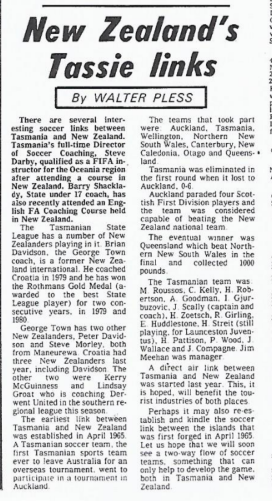
Walter Pless article from Soccer Action
April 22 1981, looking at Tasmanian
soccer's connection with New Zealand.
After the break, 100 Years Ago Today, where we visit Melbourne and find the paper's get a name wrong, and we look at some match reports - and foreshadowing the difficulty we'll have in getting results for Melbourne games in 1920. Then to Newcastle, with a surprising of amount of Catholic schools in competition; and the goings on at Weston, and consternation about the rules surrounding substitutes. And finally to Hobart, and more members of the Honeysett family than you can poke a stick at.

After that segment, some chat about the collaborative project set up by Tony Persoglia to set up and maintain a database (sorted by state) for interstate competition, and tour games by visiting clubs and visiting ships. We look at some of the strange outlets finding games to put in said database - including New Zealand's answer to OzFootball, Ultimate NZ Soccer. We also look at the historical posts being put up during the lockdown by Walter Pless, looking at key moments in Tasmanian soccer. And finally a shout out to the existence of the Facebook page dedicated to the Darwin Cubs, who participated in the Singaporean league in the mid-1990s.

In the final segment, Ian returns to an early part of his research, looking once more at early soccer in Mildura and Irymple, with new information thanks to some recent updates to Mildura newspapers on Trove - including the referee of Enoch Blount during a game between Mildura and Melbourne representative sides, after he was struck by a ball during the game.

Thursday, 3 October 2019

Episode 24 - George Cotsanis; cocktails; films; Chaplin Reserve

George Costanis handing over "The Romans Are Coming"
film reel to a representative of AS Roma.
Download and listen to episode 24.

This week we're joined for the whole episode by special guest, George Cotsanis.

We look at Mark Boric updating Australian Women's state championship results thanks to some programs he's received, after which he created a page which included footage of 1980s of said championships donated by Deb Nichols.

Ian gripes about the name of a cocktail at the Plough Hotel in Footscray vis a vis a political stance on the Footscray Park issue. Paul isn't as fussed by said menu item.

Then an update on Paul's map project.

After the break, Cotsy absolutely butchers the 100 Years Ago Today sting. See this link for more on this week's 100 Years Ago Today, which incudes discussion Albany and Denmark in Western Australia, and the broken promises made to Caledonians in Western Australia following their commitment to war efforts.

We collectively lament the lack of time in modern life, where the social aspects of soccer (and sport) are harder to maintain.

Then we get to discuss - finally - Cotsy's film collecting and digitisation. This includes:
We discuss

  • the process of access, digitisation, preservation, and copyright. 
  • the films themselves.
  • the nature and value of these games.
  • the visit of Roma to a VFL game. 
  • And of course, Cotsy's interaction with Roma itself, who were pleased to be able to put their film into their museum.

See Cotsy's YouTube Channel for more of his videos.

We also have time to mourn - for real this time - the passing of Chaplin Reserve in Sunshine.

Thursday, 1 August 2019

Episode 16 - Footscray, Footscray, it's a hell of a town!; Preston Makedonia match programs

Download and listen to episode 16 here.

Albury kicks off at night, or so Paul has been told. (you can also hear Paul shuffling papers like he's channeling his inner Birchabald T. Barlow)

We get an answer from Mark Boric as to why Victorian clubs took so long to start their season in 1919.

Thanks to Travis Faulks, we finally get some Illawarra content, including historical nicknames!

(also we get promised an intern, a promise which fails to materialise)

Thanks to Garry McKenzie, we get an overview of Brisbane church soccer.

Then 100 Years Ago Today with Victorian scores, and no news... a West Australian team misses its train... then to Newcastle and code-harmony...  a Brisbane story tickles Ian's code-war and class-war yearnings... in Goobumgee, there's some games being played, where Ian takes on the legitimacy of "dance committees" to Paul's displeasure...

After the break, it's back to talking about Footscray, providing a historical overview of soccer in the area, including clubs and grounds across the decades. Footscray City, Footscray United (two kinds), Footscray Capri, Footscray JUST... more Footscray content than you can poke a stick at. Plus all the usual digressions into public space, suburbia, works teams, etc.

In the final segment, Paul looks at some old Preston Makedonia match day programs from the late 1980s - they're rather good, with a lot of interesting content spanning supporter etiquette, advertisements, politics, nationalism, overseas soccer, news, player profiles, battles with local councils, even some poetry,  - but most importantly about what the editorial style says about the balance the struggle to exist between two cultures.

Thursday, 25 July 2019

Episode 15 - Soccer club nicknames; Newcastle (looking for foundations); battle over public spaces

Download and listen to episode 15.

In this episode Ian falls down the wormhole of Sid Grant and Harry Hetherington's 17 volume History of Soccer in New South Wales on Mark Boric's site.

We also quickly covered the uploading by some pseudonymous character of footage from the 1982 Coppa Italia final in Melbourne - as broadcast on SBS, and commentated by Laurie Schwab - and the value of these items, and the difficulty in finding them and preserving them.

Ian notes that he and Roy Hay have each contributed a chapter to the scholarly text The Early Development of Football.

Then comes 100 Years Ago Today, which includes some discussion of the phrase "soccer rules".

After the break is a discussion of certain Australian soccer nicknames (especially in New South Wales), which followed on from a discussion a couple of weeks prior. Listener Graeme McGinty wrote in to explain why certain flowery names were chosen, and Ian read this letter out on air. McGinty's letter suggests the "pretty" names were chosen to disassociate themselves from either (Protestant/Catholic) sectarianism, or from the harshness of the industrial work many soccer players would have been involved with in the late 1800s or early 1900s.

Ian segues into looking at the foundations of Newcastle soccer.

Then in the final segment we wade dangerously into contemporary issues by looking at Melbourne Victory's attempt to acquire a lease for land at Footscray Park, by trying to steer the conversation towards the historic difficulty that soccer has had in obtaining grounds at the margins of councils, or on the worst public land. Paul refers to in particular to Schintler Reserve chapter (in other words, the struggle for soccer to access land in Footscray) in John Kallinikios' Soccer Boom. 

But we also look at the concept of passive recreation; and then taking that further by looking at the comparable historic situation at Middle Park and Albert Park, using Jill Barnard and Jenny Keating's People's Playground as a guide for how people interested in this topic should broaden their ideas of us and them when it comes to public space in Melbourne.

Thursday, 6 June 2019

Episode 10 - Greg Downes and international women's soccer; Melbourne Victory and Footscray Park

Download and listen to episode 10 here.

We begin the show by discussing Aussie rules historian Rhett Bartlett's personal funding of the scanning of The Richmond Guardian newspaper on Trove, and the practical and ideological possibilities - good and bad - of historians self-funding of work which would ordinarily be left to governments.

Then we get rapped on the knuckles - justifiably - by our New South Wales listeners, for our ignorance of who the writer "Celtic" was. Paul chooses to lay the blame

Then 100 Years Ago Today, where the soon to be famous segment sting begins to emerge from the primordial ooze, and where we travel to Toowoomba, Woonona, Thirroul, Melbourne, Brisbane, and Jervis Bay. And hipster soccer balls!

Then we chat to Greg Downes about women's international football, in the lead-up to the women's World Cup, and the increasing popularity of women's soccer both at home and abroad. Greg delves into:
  • the origins of Australia's participation in international women's soccer 
  • another missing trophy
  • how the teams funded their overseas trips
  • the messy way that international diplomacy sometimes got in the way of overseas participation 
  • the restrictions placed on women's soccer by male governing bodies
  • the logistical obstacles for players to make their way into the national team - fundraising, remoteness from NSW and Queensland's dominance of women's soccer.
And then Greg makes a guess as to who will win the tournament... did he get it right?

Then Ian tries to resuscitate his Sacred Sites segment by calling it Grounds For Discontent. The segment focuses on social media interactions regarding Footscray Park and Melbourne Victory. Is it an issue that's a bit too contemporary for a history show? Can you be ambivalently antagonistic? I mean Ian does manage to eventually get into the history of Footscray Park and soccer. Oh, the persistent problem of grounds - we trawl across the issue across states! And how should (and are) private and public sporting clubs treated differently, and what are the historical resonances between historic disputes over professional sporting clubs vs (nominally) amateur ones?

We finish the show by looking very briefly at the issue of triangulation - reading beyond one kind source, and corroborating trends and facts by looking at a wider variety of material. This is prompted by Paul's reading of a book on the Glebe Rugby League Football Club, which almost entirely omits the existence of soccer in Sydney to puzzling ends, though perhaps not as much as the Melbourne historian Marc Fiddian's near complete overlooking of soccer in history on the Brunswick Street Oval.