Showing posts with label Walter Pless. Show all posts

Thursday, 17 June 2021

Episode 84 - A look at the Football Belongs documentary (with Jason Goldsmith)

Download and listen to this episode here.

We're back after a week's break... well, mostly. Ian's decided to take the rest of June off, so Paul is joined in hosting duties by Jason Goldsmith - and we get an update on his and Lucas Gillard's book Be My Guest. We also quickly look at Ange Postecoglou signing up as Celtic manager, and a missing section on Ange's Wikipedia page. We also get way out of the show's wheelhouse by discussing contemporary football broadcast arrangements.

We also look at Walter Pless' obituary for Tasmanian soccer great George “Chopper” Arnott. We give props to Greg Stock for his ongoing OzFootball work. We also note that Tony Wilson and Rob Heath, who are making the Ferenc Puskas in Australia documentary, are still looking for footage and photographs, as well as accepting tax deductible funding support via their Documentary Australia Foundation page.

Our main focus this week is the full length Football Belongs on Optus Sport. We look at the following topics:

  • Who is this for? Who is this being addressed to – considering Ange’s comments about trying to force the game through to cultural centre stage, having it on Optus only, means its going to be seen by soccer football fans only - if "Football Belongs", where and how does it belong exactly? And will it reach the Eurosnobs within Optus' reach.
  • The beginning and end with John Moriarty.
  • The way the documentary resets the narrative of the past 15 years of Australian soccer and its immigrant/ethnic character.
  • The breadth and limitations of its diversity - including the lack of almost any non-English language interviews. And no Jews!
  • The general (and understandable) paucity of women in this documentary.
  • The way the documentary demonstrates that the clubs within these communities are not just football clubs - they are community and social welfare organisations.
  • The way that sometimes the use of non-football people (like Mario and Paul Fenech) detracted from the story.
  • Craig Foster articulating the point that Australian soccer needs to utilise its demographic and cultural reach to change the very nature of Australian society.
  • We also have some talkback callers throughout this segment! Very good point made by Paul Hunt calling in, asking when are going to start looking at stories like this from a football first, rather than ethnicity first perspective.
  • The way in which the film ignores places and demographics in Australia where soccer has always belonged.
After the break we have another caller, asking about why the film shirks away from the matter of why communities have walked away from the ethnic soccer club milieu. Paul makes the point though, that the documentary is called "Football Belongs" not "Football Belongs?", and that the attrition of support for senior grade soccer in Australia goes across the entire country, in both recent and more established soccer strongholds.

And finally, 100 Years Ago Today, where there are a lot of articles discussing what sport is appropriate for women to play, but we’ll leave them until next week when we have Garry McKenzie on. We start off in Mackay, where a new local club is being formed; then head over to Bunbury, for an Australian Rules footballer with an unusual nickname; and then do a sort of deep dive into the Queensland state team's tour of New South Wales, where they fare poorly against against some of the local elevens, but do very well against the New South Wales state side; there's also a remembrance of the Victorian state team, and the hope that they would one day assemble a state squad once more, as they did prior to the war. We look at the different media perspectives of the tour, and some match reporting styles that could be deemed quite harsh on players by today's standards; we look at some of the curtain raiser matches played on that tour, and some sweeping changes to the committee overseeing soccer in the Kogarah district; and down south in the Illawarra, we have a no-show team, and a case of very poor hospitality by a host governing body.

Thursday, 7 May 2020

Episode 38 - Pandemic catch-up melange

Victorian club Northumberland & Durham,
pictured with the Dockerty Cup in 1914.
Download and listen to episode 38 here.

Paul and Ian are back on the air, from the comfort of their respective homes instead of from in the studio. We get Footscray Park bingo out of the way, with an article from the Argus from 1924, looking at the supposed "rugby-soccer" threat in Footscray as an argument for admitting the Footscray Football Club to the VFL in 1925. The article emphasises both the rapid growth in soccer, and the poor facilities of soccer. The writer perhaps exaggerates the potential of soccer in Melbourne to grow to such a stage where it could obtain enclosed grounds, but the article does show that there's an awareness of soccer as it exists in Footscray, where two of Victoria's strongest soccer clubs were playing out of at the time.

We also look at a high resolution photo of Northumberland & Durham, sourced via an English family collection - and we ponder the possibility of much of Australian soccer photo and artefact history residing in the United Kingdom. Then to the Mark Boric Express, who continues to upload materials to his blog. Kudos also to Simon Boegheim and the Queensland Football History Association and the work they've been doing. The former writer on Australian soccer Jesse Fink has released an abridged digital version of his book 15 Days In June, about the Socceroos circa 2006 and before. Then some general meandering chat about the effects of the pandemic on all of us. Then some theory-based venting and thinking out loud about a particular criticism of Joe Gorman's Death and Life of Australian Soccer, in that he "wasn't there, so how could he write about it".

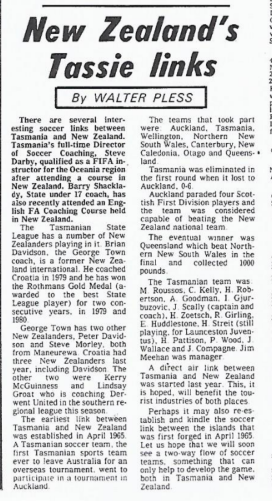
Walter Pless article from Soccer Action
April 22 1981, looking at Tasmanian
soccer's connection with New Zealand.
After the break, 100 Years Ago Today, where we visit Melbourne and find the paper's get a name wrong, and we look at some match reports - and foreshadowing the difficulty we'll have in getting results for Melbourne games in 1920. Then to Newcastle, with a surprising of amount of Catholic schools in competition; and the goings on at Weston, and consternation about the rules surrounding substitutes. And finally to Hobart, and more members of the Honeysett family than you can poke a stick at.

After that segment, some chat about the collaborative project set up by Tony Persoglia to set up and maintain a database (sorted by state) for interstate competition, and tour games by visiting clubs and visiting ships. We look at some of the strange outlets finding games to put in said database - including New Zealand's answer to OzFootball, Ultimate NZ Soccer. We also look at the historical posts being put up during the lockdown by Walter Pless, looking at key moments in Tasmanian soccer. And finally a shout out to the existence of the Facebook page dedicated to the Darwin Cubs, who participated in the Singaporean league in the mid-1990s.

In the final segment, Ian returns to an early part of his research, looking once more at early soccer in Mildura and Irymple, with new information thanks to some recent updates to Mildura newspapers on Trove - including the referee of Enoch Blount during a game between Mildura and Melbourne representative sides, after he was struck by a ball during the game.

Sunday, 16 December 2018

Episode 6 - Walter Pless; school soccer; State Federation histories

Tasmanian soccer journalist and historian
Walter Pless had a chat with us.
Download and listen to episode 6.

On our final episode for the year, we began the show with some feedback courtesy of Athas Zafiris, who had a justified bone to pick with us about our discussion on the 'digital narrowness' discussion during the previous week's episode.

In the '100 Years Ago Today' segment, Ian discusses school soccer.

We also chatted with Tasmanian soccer journalist Walter Pless. During the interview we covered Walter's personal soccer journey, his decades of soccer journalism, his shift into blogging and historical writing, and measuring the playing dimension's of Hobart's soccer grounds (link is archived from the original).

Then Paul discussed the various state federation's historical offerings, of which South Australia's Hall of Fame and especially Western Australia's broad sweep of history are the clear leaders of an otherwise bad bunch.

We also thanks a whole bunch of people for their support over our six-week pilot period.