Showing posts with label Joe Gorman. Show all posts

Thursday, 8 October 2020

Episode 59 - The rise and fall of the Leopold Method


Paul continues to lose the battle against so-called banter.

We begin with the menu at a welcoming dinner in Grahamstown (now Makhanda) in the Eastern Cape in South Africa, during Australia's tour of that country in 1950, where we discuss what goes into the dish known as camp pie. We also note Greg Stock's work with reformatting and updating the Socceroos archive on OzFootball, especially with regards to early 'B' internationals. We also discuss Mark Boric's successful attempt to revive files on his old Amiga.

We also look at Travis Faulks' (and friends) rescue of one of the oldest extant Australian match programs - a 1925 program for Illawarra vs the touring English FA side. Paul focuses on the program ads, naturally, but we also get some audience feedback on Bode's Oval, and only skim over the England players and personnel (John Lewis; Jack Elkes; Charlie Spencer; Billy Williams; Billy Caesar; Stan Charlton; Leonard Graham;)

(there's also mention of a new book on the Murray Bridge United Soccer Club, but hopefully something more substantial on that in a coming episode)

In a bloated 100 Years Ago Today, we begin in North Queensland, with another charity cup, and another team wearing sashes every which way, looking back to an earlier episode; then to Sydney for the Gardiner Cup final, where we look at the strength of the Balmain district in soccer; down to Wollongong (and Bode's Oval again) for 8-Hour Day sports, with football of course, but also coursing; then skipping ahead a few years to outrage over coursing, which seems to maybe falling out of favour; catching up with the Australian Trustee club championship; and time not permitting (maybe if there was less banter at the start of the show) we have to leave Western Australia out this week, though you can always look back at it on the blog post.

Cover art of Besart Berisha, intended for the unreleased
fourth issue of Leopold Method.
Credit: Jamie Osborne.
In our final segment this week we look at the short-lived Australian quarterly soccer journal Leopold Method, which ran from 2014-2015. Leipold Method, the brainchild of soccer fan and author Shaun Mooney, was originally a website, before Mooney decided to create a journal for long-form, incisive soccer writing. 

Key to the Leopold Method's (and Mooney's) particular outlook on Australian soccer was Leopold Baumgartner's autobiography from the late 1960s, which apart from discussing Baumgartner's own life in relation to soccer, also espoused a clear idea of what Australian soccer needed to do to progress: divest itself of petty, short-term politics, and invest its efforts into developing junior talent playing the right style of soccer.

Within that context, we look at:
  • The move from website to print, at a time when it seemed riskier than ever to move into print publishing.
  • The subscription based "kickstarter", which attracted support from many corners of Australian soccer - players and their union, ordinary supporters, and administrators. 
  • The stable of young (and old) writers which came through the journal during its short run, including Vince Rugari, Kate Cohen, Ian Syson, Joe Gorman, Ian Syson.
  • The fact that it paid writers for serious, long-form writing on history, tactical analysis, player development, and Australian soccer politics and business.
  • The way that the goodwill that was built up by the subscription drive and the central ethic of the project, was undone by the non-appearance of the journal's fourth issue - and the lack of communication 
  • The disappearance of not just the print edition of the journal, but also the website from which it sprung - which now exists only on the Wayback Machine - which speaks to the lack of permanence of the digital realm.
  • But also the retreat of Mooney from public comment and participation in Australian soccer social media circles; and editor Joe Gorman's eventual retreat from Australian soccer writing as a whole.
  • Ian's wry and pertinent observation that Leopold Method was like the Russian Revolution - in that there was only one  chance to get it right.
  • The nature of Leopold Method's disappearance being in part a victim of its own success.
  • What kind of legacy thee journal left in its wake - the talent it nurtured which was poached into various other media organisations; the opportunity it gave academics to write and promote their won work in history; the difficulty for future publishers in coming after Leopold Method had seemingly burned much of the goodwill for such an enterprise in such a short space of time, 
For access to digital copies to the three editions of Leopold Method, visit Mark Boric's site.

Thursday, 7 May 2020

Episode 38 - Pandemic catch-up melange

Victorian club Northumberland & Durham,
pictured with the Dockerty Cup in 1914.
Download and listen to episode 38 here.

Paul and Ian are back on the air, from the comfort of their respective homes instead of from in the studio. We get Footscray Park bingo out of the way, with an article from the Argus from 1924, looking at the supposed "rugby-soccer" threat in Footscray as an argument for admitting the Footscray Football Club to the VFL in 1925. The article emphasises both the rapid growth in soccer, and the poor facilities of soccer. The writer perhaps exaggerates the potential of soccer in Melbourne to grow to such a stage where it could obtain enclosed grounds, but the article does show that there's an awareness of soccer as it exists in Footscray, where two of Victoria's strongest soccer clubs were playing out of at the time.

We also look at a high resolution photo of Northumberland & Durham, sourced via an English family collection - and we ponder the possibility of much of Australian soccer photo and artefact history residing in the United Kingdom. Then to the Mark Boric Express, who continues to upload materials to his blog. Kudos also to Simon Boegheim and the Queensland Football History Association and the work they've been doing. The former writer on Australian soccer Jesse Fink has released an abridged digital version of his book 15 Days In June, about the Socceroos circa 2006 and before. Then some general meandering chat about the effects of the pandemic on all of us. Then some theory-based venting and thinking out loud about a particular criticism of Joe Gorman's Death and Life of Australian Soccer, in that he "wasn't there, so how could he write about it".

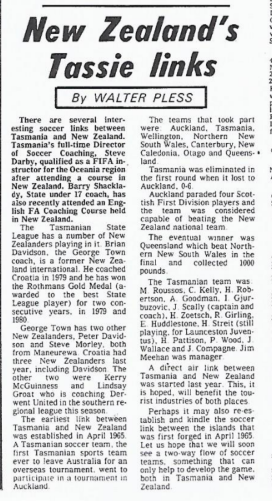
Walter Pless article from Soccer Action
April 22 1981, looking at Tasmanian
soccer's connection with New Zealand.
After the break, 100 Years Ago Today, where we visit Melbourne and find the paper's get a name wrong, and we look at some match reports - and foreshadowing the difficulty we'll have in getting results for Melbourne games in 1920. Then to Newcastle, with a surprising of amount of Catholic schools in competition; and the goings on at Weston, and consternation about the rules surrounding substitutes. And finally to Hobart, and more members of the Honeysett family than you can poke a stick at.

After that segment, some chat about the collaborative project set up by Tony Persoglia to set up and maintain a database (sorted by state) for interstate competition, and tour games by visiting clubs and visiting ships. We look at some of the strange outlets finding games to put in said database - including New Zealand's answer to OzFootball, Ultimate NZ Soccer. We also look at the historical posts being put up during the lockdown by Walter Pless, looking at key moments in Tasmanian soccer. And finally a shout out to the existence of the Facebook page dedicated to the Darwin Cubs, who participated in the Singaporean league in the mid-1990s.

In the final segment, Ian returns to an early part of his research, looking once more at early soccer in Mildura and Irymple, with new information thanks to some recent updates to Mildura newspapers on Trove - including the referee of Enoch Blount during a game between Mildura and Melbourne representative sides, after he was struck by a ball during the game.

Thursday, 10 October 2019

Episode 25 - Our favourite books; maps; Alec Barr and hit and run drivers

Download and listen to episode 25 here.

In this episode we look at Mark Boric digging out the history of the Scots-Australian soccer journalist from the 1950s-1980s, Alec Barr, and Barr's history as a player, journalist (and his bias against certain clubs, see also here), and convicted reckless driver, after he killed two journalists in a car accident.

We discuss the progress of Paul's Australian soccer cultural map, and especially the Brompton Speedway in South Australia, and Ted Rowley's relationship to that one-time soccer ground and later speedway.

Ian then pines for Joe Gorman, and Gorman's absence from Australian soccer writing.

The bulk of the episode is spent discussing a listener's suggestion about what Australian soccer history books we recommend. Ian couldn't keep himself to five, so he preempted his five choices for the radio by putting up a longlist before the show.

For the record Ian's five books mentioned on the show were:
  • Soccer in New South Wales, 1880–1980, by Phil Mosely
  • Soccer Anzacs: The Story of Caledonian Soccer Club, by John Williamson
  • The Aboriginal Soccer Tribe: A History of Aboriginal Involvement with the World Game, by John Maynard (updated in 2019)
  • A History of Football in Australia, by Roy Hay and Bill Murray
  • The Death and Life of Australian Soccer, by Joe Gorman
Paul's selections were the following, with links to reviews by Paul where available:
Another item to look at, though a little out of date now, is Roy Hay's Bibliography of Australian Soccer.

If you're wondering what happens at the end of the show, I get rudely interrupted by people in the control room outside bursting in with an unsolicited and frankly rude barrage of noise celebrating a Socceroos goal against Nepal.