Showing posts with label Socceroos. Show all posts

Thursday, 24 June 2021

Episode 85 - Establishing and maintaining Australian soccer history's web presence

Download and listen to this episode here

This week Paul is joined in hosting duties in the studio by Greg Stock, and remotely by Garry McKenzie.

Paul notes that he received a present from Greg in the mail, which took so long to arrive that Greg ended up in Melbourne before it. Paul wraps up some Football Belongs feedback, including a tribute at Edensor Park for Ivan "Gilligan" Rendulic. Garry discusses trying to figure out whether there was a family connection between Alec Gibb (Socceroo #51) and Angus "Billy" Gibb (Socceroo #51a) - and an explanation of how mistakes like "missing" Socceroos get made, and then corrected. Greg talks about the process of starting the process of rehabilitating the accuracy of OzFootball's National Soccer League records, and the processes involved in making decisions when informed by sources with contradictory information. We also look at the revamped format of the pages, which will include links to match programs and match footage.

Our main discussion this week focuses on Football Australia's relaunch of the historical online pages, and the status of the equivalent state pages - where they exist. We discuss the holes and shortcomings and mistakes of FA's effort, but we also acknowledge that it's a massive step in the right direction, and we look forward to seeing how future improvements, now that the framework is in place. Especially pleasing is that the Hall of Fame has now been updated significantly from its previous semi-derelict state. And how much information is too much? And what's the next step? And how maybe, just maybe, that the existence of an Australian soccer history community means things like this project happen.

But going around the state federation history websites, and while the situation generally shows improvement from previous efforts, there are still several federations with negligible online historical presence. So far have we progressed since we last did a deep dive on this issue all the way back in episode 6? Who's the benchmark now? What resources are being allocated for improvements? What's going on in the background?

In the final segment, it's a Garry McKenzie curated 100 Years Ago Today, where Garry notes that Ipswich clubs were dominating the main Queensland league competition, and the first mention of the Tristram Shield; then to Weston, and the death of a local soccer player known only as "Pearce"; there's also the death of Edwin (Teddy) Aldred, an English footballer who had played for Leeds City's reserves, an had an extended - albeit contested - history of playing soccer in Australia; and we look at the beginnings of women's soccer in Australia, as discussions start in the press about going ahead with such a project.

Thursday, 8 April 2021

Episode 75 - Greg Werner on the late Vic Dalgleish

Download and listen to this episode here.

We begin this show with a clarification - contrary to popular perception of his public persona, Paul actually thinks Australian soccer is going well, which is not the same thing as his own team going well or not. Then a digression into the fleeting overlap between Australian soccer and professional wrestling.

Some good work in the uploading scene with Mark Boric working with Frankston and Mornington Peninsula soccer historian Laurence Hall. We look at a fine obituary for Matthew Boubaris, a Darwin soccer identity of some note, that appeared in Neos Kosmos.

We finish the segment by looking at soccer (history) videographer Ben Coonan's appearance on Hard Quiz, with his specialty topic of the Socceroos.

Our returning guest this week is Greg Werner to discuss the soccer life of Vic Dalgleish, a notable coach originally from Glasgow, and based in Sydney. But first - we discuss Greg's appearance on Mastermind. Then we follow up a discussion from last week, where we discussed touring English cricket teams in Australia, and the soccer matches they played against local sides. Most curious is the idea that those sides - which sometimes included league footballers - would have been the team in Australia when they were in the country.

We then move on to talk about the legacy of the late Vic Dalgleish, a Football Australia Hall of Fame member, and a prominent coach in Sydney, especially in Sydney suburbs that were not then known for soccer. Dalgleish was a NSW state junior coach, and led the Joeys during a successful period in the 1980s. The testimonials from those See also this brief obituary on the Football Australia website.

Greg sticks around for the 100 Years Ago Today segment, where we begin with Sydney with attempts to "rehabilitate the Commonwealth Football Association". Paul asks the question about when the Australian soccer bodies tried to get the English FA to send a team out, whether the Australian bodies ever tried to include New Zealand as part of their attempt to bring out an English touring team; oh, and the formidable logistics of travel and making your money back. The we try to sort out what flavour of politics was Sydney soccer connected to. Then no signs of argument about whether the Newcastle United Club pf the 1920s can be considered a continuation of its pre-war self. Following is a comparison between the attitudes to women's sports overseas and in Australia, and what women are being allowed to do. And finally to Geraldton, where the three clubs are preparing for the new season.

Thursday, 18 February 2021

Episode 70 - Greg Stock on the late Frank Parsons

Download and listen to this episode episode here.

Ian's incapacitated this week, so he's doing the show from home. In what Paul complains is an over-long opening segment, we take a quick look at the initial effect of Facebook's ban on Australian news sites from an Australian soccer perspective.

Then - was Melbourne's 1920s Preston club a district club, or was it based on ethnicity, namely Lancashire identity? Then after a bit more dawdling around promoting upcoming Fairplay Publishing books and an incident with an exhausted player in Perth in 1952, and look forward to Queensland's Wynnum club looking forward to celebrating its 100th anniversary. Ian gets excited about a possible revolutionary discovery about the origins of football as we know it( Australia. Then some thoughts on a tennis manuscript Ian's been reading.

The finally it's time for 100 Years Ago Today, where we start in Newcastle and West Wallsend; the South Australians being challenged to a soccer match by the touring English cricketers; a meeting of ships in Tasmania; the Victorians are reporting on overseas football; new clubs are sporting in Brisbane; and preparations are being made for the new soccer season in Perth.

In our middle segment we chat with regular guest Greg Stock on the passing of Frank Parsons, former player and administrator. Little remembered today, Parsons was a leading striker in New South Wales in the 1940s and 50s, and later an important administrator in the transition from the old NSW regime to the new Federation setup. Greg talks about Parsons scoring proficiency - perhaps second only to Reg Date at the time - which led to both state and national representation, but also  controversy with how that representative career ended. We discuss Parson's later life, and the reasons for his current obscurity compared to some of his contemporaries, and the cultural forces which have made it more difficult fo know about pioneers like Parsons. 

We finish this segment with a quick word about the passing of former Socceroos coach Joe Venglos, whose long coaching career began in Australia in the 1960s, where he managed Sydney Prague, New South Wales, and the national team, where he introduced tactical innovations to Australian football that otherwise passed the local game by. We note that the central European influence of coaches and players like Venglos has largely been been forgotten in the 50 years since the peak of Hungarian, Czech, and Austrian influence on Australian soccer.

For Greg's interview with Parsons from 2008, see this link.


We close off the show with Paul talking about a book he read on the day of the show, the Archie Thompson biography What Doesn't Kill You Makes You Stronger. Seemingly pretty much consigned to the bargain bins soon after its release, Thompson's biography is a mix of his life story (up until 2010) and his motivational life and playing philosophy. Paul notes that while some of Thompson's views on modern medicine, as well as his performance as a current special comments man for the A-League have led to contemporary soccer audiences dismissing his points of view - it's worthwhile digging into this book for its historical coverage. Thompson's career spans the later NSL and early A-League eras. In the former, he plays with a ra discard egional team, a fully-professional team, and a leading ethnic team; in the latter, he is one of the first totem players for Melbourne Victory and the A-League, around which that club and competition builds its identity.

Ian observes that Paul seems to be increasingly obsessed with stories like Thompson's (and Tim Cahill's)  which include unusual origin stories, which diverge from more familiar pathways to professional football in Australia. Thompson's cultural background (New Zealand/Papua New Guinea), his childhood in regional centres like Lithgow and Bathurst, not known for being soccer hotbeds, and the fact that Thompson gave up soccer in his teens all provide material for an unusual and important story. One can skim over the more "philosophy" Thompson's attention to detail on various teammates, and the process of climbing the long-ladder to success makes for a worthwhile addition to the Australian soccer biography canon.

Thursday, 23 July 2020

Episode 48 - Early days of SBS soccer; Tarrawanna's poor sportsmanship

Download and listen to this episode here.

Paul talks about something stupid he did a few weeks ago, namely the purchase of a medal from the 1926 Dockerty Cup.

Moving on to video games, and an edit file for Pro Evolution Soccer 2020, for which someone has compiled a 1990s National Soccer League league and team set.

Then on to what people have been scanning and uploading.

Paul notes that while trying to find articles with tags in Trove (to help Ian), he came across two letters - one by a J.O. Wilshaw a soccer person, and one by George Cathie, a former VFL player and delegate, and one time editor of the VFL's Football Record. In these letters from early 1953, Wilshaw puts forward the case for why soccer should get access to an enclosed ground in Albert Park, while for his part Cathie responds by making stuff up about soccer in the 1880s both in Australia and in England.

After the break it's time for 100 Years Ago Today, first off to Hobart, where the HMS Renown manages at last to not lose a game, albeit in fortuitous circumstances; to Melbourne, and an extended discussion on the return of the England vs Scotland game for the first time since the end of the war; then to Newcastle, where we look at the recently improved spectator amenities of the Tramways Ground; then south to the Illawarra, where after looking at some results, we get into a heated letter writing stoush on Tarrawanna's apparent lack of sportmanship and manners, with real beaut 1920s polite outrage.

In the final segment, after noting watching a video of Anderlecht-era Eddie Krncevic, Paul discusses this 1980 review of soccer by SBS, as uploaded by George Cotsanis from a video given to him by Tim Paton. An artefact from the very earliest days of SBS TV, Paul discusses:

  • the host of the review, Vladimir Lusic, whom Les Murray described as "the quintessential ethnic, almost a living and breathing caricature of the New Australian".
  • the critical tone of soccer discussion which SBS brings to the table from the start, and which goes on to influence the nature of Australian soccer discourse for decades to come - including when rival networks seek to play against that tone - as well as a comparison with other sports and their networks.
  • the sheen which has worn off the national team since 1974, and the the decline in optimism in the game's fortunes as a whole.
  • the sideline and media persona and antics of Socceroos coach Rudi Gutendorf
  • a very uncomfortable press conference with Gutendorf, Socceroo captain Murray Barnes, Australian Soccer Federation chairman Arthur George, and Tasmanian delegate Vic Tuting
  • what seems like a gradual degradation of team spirit amid mixed results of a long overseas tour.

Thursday, 4 June 2020

Episode 42 - Greg Werner and Grassroots Football Project

Apologies for the technical issues, as usual. Maybe even a bit more this week.

Download and listen to episode 42 here.

We begin the Mark Boric Express - he's still uploading stuff, and still struggling to make sense of rectifying incorrect and incomplete Victorian results and league tables from the 1920s and 1930s. This leads to an esoteric discussion about mythical sources documents and regressing into unrecorded pre-histories.

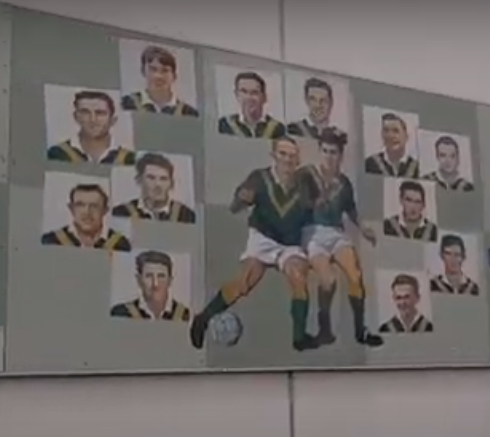
As part of Paul's cultural landmark map project, Paul has started including murals. Prompted by learning of the existence of a soccer mural in the New South Wales town of Kurri Kurri (see right)... so there begins a new phase of trying to chart the game's cultural history. Part of the problem with murals and street art is that their very nature lends them to being vandalised or painted over at frequent intervals.

We also note that there will be an FFA webinar hosted by Andrew Howe and Joe Gorman.

Moving on to 100 Years Ago Today we start with Launceston and the incongruity of starting the season in June; then to Queensland, for an interstate match between Queensland and New South Wales; to Melbourne, where the Collingwood Australian Rules club receives praise for the standard of the club's hospitality to the visiting soccer teams. Still in Melbourne, we perform our usual check of the local results; and finally to Adelaide, where the Prince of Wales' tour continues.

Our guest this week is Greg Werner, an Australian soccer historian specialising in the junior team origins of players capped for Socceroos and Matildas. After going through Greg's history as a soccer  participant - player, coach, referee - we look at his transition to becoming a soccer historian and establishing the Grassroots Football Project. The project aims to find the junior club that Socceroos and Matildas nominate as being the pivotal club - and the pivotal people at those clubs - in terms of igniting their passion for the game. We discuss how a nagging prompt in the form of unanswered question becomes an obsession; the politics of clubs trying to claim representative players as belonging solely to them, often at the expense of smaller, less well-known clubs; the difference in attitudes between male and female players towards being contacted for historical projects; Greg being tapped on the shoulder to assist with the completion of the Encyclopedia of Matildas; players who now eschew any contact related to soccer, having left that in the past; and of course the usual methodological quirks and obstacles encountered while doing historical research.

We finish off by discussing Optus Sport's Football Belongs series, which at the time of broadcasting was just about halfway through its intended run of 14 episodes. The series focuses on European migrant communities and their connections to the local game, intended to line up as a promotional tool for Optus' coverage of the (now cancelled/postponed) Euro 2020 tournament. Paul (who has watched parts of the series) and Ian (who hasn't) discuss the bigger picture of what Optus might be trying to achieve with its efforts here and elsewhere to create Australian soccer history content. We look at what the series - made up of short, five minute episodes focusing on a different ethnic group each time - tries to do. It's an attempt at a remedy for the ethnic club bashing that Australian soccer has taken part in for the better part of the last two or three decades; we look at how that fits in with an apparent general desire to continue on the sort of path of reconciliation, evident since the establishment of the FFA Cup in 2014.

But Paul also discusses the things left out of the series so far, and the discursive issues those absences create. There's the near total lack of women players interviewed, with most women interviewed being at best ancillary members of the soccer community; the lack of almost anyone from outside the specific ethnic groups discussing their place within the specific ethnic club structure they find themselves in; and those people who had been involved with those ethnic soccer clubs, who ended up moving away from that particular scene for various reasons.

To a degree much of this is understandable - the series is meant to be a short, punchy, quietly celebratory look at communities which have nurtured soccer in Australia in difficult circumstances. But Paul wonders whether some balance could've been found for a more even argument's sake; to wit, Paul brings up a piece written in 1995 by the late journalist Wanda Jamrozik, which looks back in a nunaced way at what it was like to support Croydon Kings (then Polonia) in Adelaide back in the early 1970s from the persectpive of a 12 year old girl

Thursday, 5 December 2019

Episode 30 - Lee McGowan and the Matildas; remembering Pim Verbeek; ball boys

Download and listen to episode 30 here.

On this week's episode, fill-in co-host for Ian Syson, Tony Persoglia, is sick, so we've co-opted Lee McGowan - who was in the studio to talk about his book anyway - for the whole hour.

We begin as we usually do, by noting the progress of the Mark Boric Express, which this week saw Mark meet up with Greg Stock somewhere in the middle of the regional Victoria to make an exchange. Check out Mark's Twitter feed for news of his updates, or head straight to the where all the goodness ends up.

The former Socceroos coach Pim Verbeek died last week, and we have a segment which covers the somewhat perplexing (to Paul, and a few others) reaction to Verbeek's passing - someone who was arguably largely unloved across the board during his time as Socceroos coach from 2007-2010. Yet as news of his passing came to light last week, there was a respect shown online for Pim that seemed to surpass mere sincere condolences for his family and friends. We look back at how Pim came to be Socceroos coach (including a diversion into the man he beat for the job, one time coaching wunderkind Philippe Troussier); his blunt, honest manner on the quality of the players at his disposal, and the quality of the A-League; the still mystery laden disaster of the Socceroos' opening game of the 2010 World Cup, and the reaction to that at the time; and the ways in which perhaps those in the media and football administration got to see a different side of Pim than what the public did.

(see also Bonita Mersiades' piece remembering Pim Verbeek)

We also noted that a new sports museum has opened in the small town of Rochester (about 180kms north of Melbourne), specialising in sports apparel from the 4,000 item strong collection of John Forbes (not the poet), who worked at Puma for 24 years. The museum probably specialises in cricket and AFL merch, but it's not known what soccer material the museum has in its collection - so if that was the main purpose of your visit, it'd probably be best to call the museum in advance. The museum is open on Thursdays, Fridays, Saturdays, and Sundays from 10am to 4pm, and at other times by appointment. The museum doesn't have a website, but it does have a Facebook page.

In 100 Years Ago Today we look at the big announcement that the English are investigating the possibility of sending a team to Australia and New Zealand in 1921 - provided the 'dominions' can stump up the cash; more soccer folk playing cricket in the summer, this time in inner-Melbourne; some confusing same-day articles in the Wollongong press, which seem to contradict and/or supersede each other; and the brief story of one K. McCredle, a Sydney schoolboy who was a talented cricketer, and before that a talented soccer player - before his school, Sydney Boys High, discontinued its soccer program.

(see also this 2009 piece by Spiro Zavos on The Roar about the decline of rugby at Sydney Boys High, partly replaced as a sport of choice by soccer, but also due to, *cough* demographic changes *cough*)

After that extended opening, we chat to Lee McGowan about his and Fiona Crawford's new book Never Say Die: The Hundred-Year Overnight Success of Australian Women's Football (published by NewSouth), a discussion  which covers, among other things:
  • The early days of women's soccer in Australia, especially in Queensland.
  • The difficulties involved with researching women's sport in Australia.
  • Buried histories, broken continuities, and the predominance of relying on oral histories.
  • The difficulties faced by women's soccer in this country -covering funding, infrastructure, wages, injuries, but most of all, a deficit of respect.
  • The difficulty and necessity of building a culture which can withstand innumerable setbacks and overcomes many obstacles, while somehow leaving a legacy for the following generations.
  • The need to avoid imitating male sporting cultures, all while acknowledging the positive effect many men have had on the Matildas and women's soccer - but also emphasising the need to develop and promote female coaches. referees and administrators
  • And of course, the development of the Matildas from obscurity in the 1970s to mainstream, well-loved brand in the 2010s.
The episode also makes the occasional detours into football literature, ball boys, and Terry Venables.

Thursday, 23 May 2019

Episode 9 - Religion and Australian soccer; 'Playing for Australia' review

Download and listen to episode 9 here.

As Ian was staying in Hervey Bay in Queensland over the previous week, he decided to have a look at the history of soccer in Hervey Bay and the surrounding region. Digging deeper into the story of soccer in the town of Howard, the point is reiterated that the game's fortune's, especially in rural and regional Australia, are closely tied to the fortunes (and existence or otherwise) of certain industries. That expands into a discussion on analogous comparisons with migration, and then with other sports and migration, and Ian's heroics in New Zealand soccer... and the eventually back to discussing the relevance of certain kinds of mining to soccer, and not others.

We then move on to discussing the poor historical research of the new Macarthur A-League team, which claimed that football was first played in the region in 1947.

Then 100 Years Ago Today, with apologies to the Spanish flu infected week before. Religion is the theme of the week - Rechabites, Catholics, Protestants, church leagues, among others - including references to the sections on religion in Phil Mosely's Soccer in New South Wales 1880-1980. Paul asks the question, why do some religious groups seem to favour soccer more than other religious groups? Have soccer historians focused too much on class, migration, and occupation at the expense of religious affiliation, when looking at historical sporting preference in Australia?

We then move on to soccer resuming in Tasmania after the war, and noting the death JJB Honeysett, a key personality in Tasmanian soccer; and finally to Melbourne, where soccer is struggling to reconvene, with many of its players still absent,

After that we move on Paul providing a review of Trevor Thompson's Playing for Australia: The First Socceroos, Asia and World Football. Paul was impressed! With caveats! The discussion covers:
  • Thompson's previous work, One Fantastic Goal, and the environment in which that was published
  • The era the book covers, which is mostly the period between the war.
  • The overwhelming strength of New South Wales soccer compared to every other state - with the exception of Queensland - and the tension that caused when it came to national team selection, especially when it came to picking teams during tours which spanned areas outside New South Wales.
  • The club vs national team, club vs federation, and amateur vs professional tensions, and the centrality of private entrepreneurs to success of tours by overseas sides.
  • The constant pining for England, and near permanent disappointment caused by a persistent Australian colonial lackey mentality.
  • The lack of meaningful competition offered by New Zealand.
  • The tours through South-East Asia by Australian national teams. 
  • The strength of the book lying in its eye for particular details and anecdotes, such as the attempt to establish haka like war-cries.
  • The chief weakness of the book being a lack of referencing.