Showing posts with label Greg Werner. Show all posts

Thursday, 15 July 2021

Episode 87 - National Youth League footage unearthed; remembering John Anderson and George Haniotis

Download and listen to this episode here.

Ian isn't here this week. 

First up, Paul has George Cotsanis on the phone to discuss the unearthing of some rare footage, of the 1991/92 National Youth League finals series. Shared by South Melbourne youth team players Tim Schleiger and Mike Lilikakis, the footage consists of two films - a full length video of the Southern Division preliminary final, and a 20 minute highlight package of South's three finals matches from that season, against Heidelberg, Preston, and Sydney Croatia. Paul and Cotsy chat about the unearthing of the footage; its rarity; its insights into the culture of the South youth team at the time; the vision of players across several clubs, that came to be mainstays of Victorian soccer for the next 10-15 years; the archival incidental footage of Eddie Thomson and Ferenc Puskas; Olympic Park in its early 90s state; the cultural snapshot of the crowd.

We also look at what's next for Cotsy in terms of unearthing in even more rare footage... and there's some exciting possibilities! We also note the death of Michael Christodoulou, the last of Victorian soccer's nut sellers.

In our middle segment we have Greg Werner to discuss the recent passing of two Socceroos, John Anderson and George Haniotis. Greg notes that the well credentialed Anderson - who had played at Stoke in the English second division - was one of the many Scotsmen to come to Australia to play soccer in the 1960s. We discuss the reasons - lifestyle, wage caps, semi-professionalism, and limited employment opportunities outside soccer - why players like Anderson came to play soccer in Australia instead of staying in their home countries. We look at Anderson's Socceroo career, which included the 1965 World Cup qualifying campaign, as well as his successful stint in Victorian soccer, especially with South Melbourne. (credit also to Tony Persoglia for his excellent obituary).

George Haniotis' international career lasted four minutes. A steady and reliable defender in the NSL for several clubs, most notably Sydney Olympic, George was a much loved personality in Sydney soccer. But George was also a pioneer, being the first Australian to play in Hong Kong's league, reviving a soccer connection between Australia and Hong Kong that had largely lain dormant for decades.


Finally, Paul zips through 100 Years Ago Today, starting with a news item (see image on right) which mimics the Daily Mail's re-reporting methods of today; the referee abandoning the game as after a Preston player refuses to leave the field after being sent off; women's football gathering steam in New Zealand, with some favourable commentary on both the women's style of dress, but also an acknowledgement that the girls knew the game; more references to the pending women's game at Murray Bridge; two clubs for women being established in Toowoomba; more commentary, obsessed with the women's sense of dress, this time from Sydney, and with a writer rather bemused by the spectacle in the non-PC manner of the time - but which still brings to mind important questions about the inaccessibility of soccer equipment for women, as discussed with Marion Stell and Heather Reid in a previous episode; and finally, a fancy dress soccer match on skates, with insights into who popular celebrities were at the time (hint - silent film stars), as well as someone dressed as Lindsay Kemble, war veteran and female impersonator.

Thursday, 27 May 2021

Episode 82 - Remembering Joe O'Connor, Alan Garside, Bill Mahoney, with Greg Werner

Download and listen to this episode here,

We're locked down again, so we're Zooming again. Also Paul got sacked from his job. And his soccer team's out of action. So everything's going great. It's so bad, that Paul's even getting into "the banter". And there's so much of it.


Ian tries to buy a signed NSL match program, without success, which leads to Paul musing about why people would be offloading their collections, and the nature of people moving on from any code and onto other activities.

Also, Ian's finding out more about Victorian school soccer... also Paul and Ian trying to figure out what the size of Melbourne's player numbers were. This conversation seems to be meandering more than usual. 

Thank goodness that we have Greg Werner on in the second segment to get things straightened up and focused. Greg's here to talk about the recently deceased Matildas' and women's soccer coach Joe O'Connor, and former Socceroos Alan Garside and Bill Mahoney. 

Irishman Joe O'Connor and his wife Pat were at the centre of women's soccer in New South Wales from the 1960s and 1980s, and thus also at the heart of the national team in the formative decade of the Matildas.

(for some other episodes dealing with Australian women's soccer during the 1970s, when O'Connor was coaching them, see episode 56 and episode 76)

Alan Garside was part of a multi-generational connection to the Granville soccer scene. Garside was a leading goal scorer of early 1950s Sydney soccer, with his record putting him on a par with Newcastle striker Reg Date. Garside represented Australia in 'A' and 'B' internationals in the 1950s.

Goalkeeper Bill Mahoney of Newcastle also played 'A' and 'B' internationals for Australia in the 1950s.

Ian asks the question about what the strategy is for recording and discussing the story of these players; Greg suggests that's it's not just the international representatives we need to worry about, but also the large amount of state representatives, from an era when state league and interstate football held a high degree of importance. There's also the question of Australia's many 'B' international games and tour matches, which featured starting lineups that were vastly different from lineups that would have played in full 'A' internationals.

In the final segment, we have 100 Years Ago Today, where we start off in Toowoomba (and Cawdor), where Ian tries to assure us that Queensland isn't just one cultural mass, but rather a state riven with regional feeling; then to Oakey Western Suburbs, and a strange idea of what a not one-sided game looks like, and encouraging the juniors to watch the senior game to be educated; after Paul gets off his soapbox, we visit Boodua who are playing Goombunjee, and a rainbow strip; then to Hobart; then to Adelaide; then to the Melbourne results.

Thursday, 8 April 2021

Episode 75 - Greg Werner on the late Vic Dalgleish

Download and listen to this episode here.

We begin this show with a clarification - contrary to popular perception of his public persona, Paul actually thinks Australian soccer is going well, which is not the same thing as his own team going well or not. Then a digression into the fleeting overlap between Australian soccer and professional wrestling.

Some good work in the uploading scene with Mark Boric working with Frankston and Mornington Peninsula soccer historian Laurence Hall. We look at a fine obituary for Matthew Boubaris, a Darwin soccer identity of some note, that appeared in Neos Kosmos.

We finish the segment by looking at soccer (history) videographer Ben Coonan's appearance on Hard Quiz, with his specialty topic of the Socceroos.

Our returning guest this week is Greg Werner to discuss the soccer life of Vic Dalgleish, a notable coach originally from Glasgow, and based in Sydney. But first - we discuss Greg's appearance on Mastermind. Then we follow up a discussion from last week, where we discussed touring English cricket teams in Australia, and the soccer matches they played against local sides. Most curious is the idea that those sides - which sometimes included league footballers - would have been the team in Australia when they were in the country.

We then move on to talk about the legacy of the late Vic Dalgleish, a Football Australia Hall of Fame member, and a prominent coach in Sydney, especially in Sydney suburbs that were not then known for soccer. Dalgleish was a NSW state junior coach, and led the Joeys during a successful period in the 1980s. The testimonials from those See also this brief obituary on the Football Australia website.

Greg sticks around for the 100 Years Ago Today segment, where we begin with Sydney with attempts to "rehabilitate the Commonwealth Football Association". Paul asks the question about when the Australian soccer bodies tried to get the English FA to send a team out, whether the Australian bodies ever tried to include New Zealand as part of their attempt to bring out an English touring team; oh, and the formidable logistics of travel and making your money back. The we try to sort out what flavour of politics was Sydney soccer connected to. Then no signs of argument about whether the Newcastle United Club pf the 1920s can be considered a continuation of its pre-war self. Following is a comparison between the attitudes to women's sports overseas and in Australia, and what women are being allowed to do. And finally to Geraldton, where the three clubs are preparing for the new season.

Thursday, 4 June 2020

Episode 42 - Greg Werner and Grassroots Football Project

Apologies for the technical issues, as usual. Maybe even a bit more this week.

Download and listen to episode 42 here.

We begin the Mark Boric Express - he's still uploading stuff, and still struggling to make sense of rectifying incorrect and incomplete Victorian results and league tables from the 1920s and 1930s. This leads to an esoteric discussion about mythical sources documents and regressing into unrecorded pre-histories.

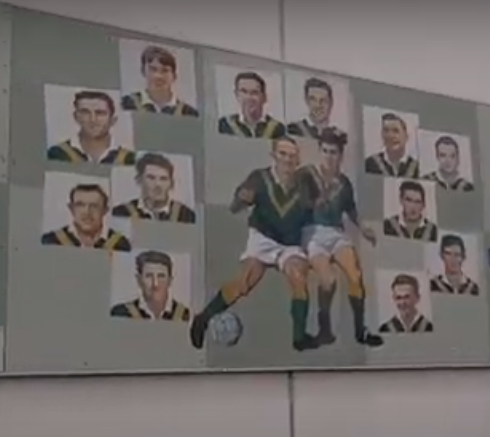
As part of Paul's cultural landmark map project, Paul has started including murals. Prompted by learning of the existence of a soccer mural in the New South Wales town of Kurri Kurri (see right)... so there begins a new phase of trying to chart the game's cultural history. Part of the problem with murals and street art is that their very nature lends them to being vandalised or painted over at frequent intervals.

We also note that there will be an FFA webinar hosted by Andrew Howe and Joe Gorman.

Moving on to 100 Years Ago Today we start with Launceston and the incongruity of starting the season in June; then to Queensland, for an interstate match between Queensland and New South Wales; to Melbourne, where the Collingwood Australian Rules club receives praise for the standard of the club's hospitality to the visiting soccer teams. Still in Melbourne, we perform our usual check of the local results; and finally to Adelaide, where the Prince of Wales' tour continues.

Our guest this week is Greg Werner, an Australian soccer historian specialising in the junior team origins of players capped for Socceroos and Matildas. After going through Greg's history as a soccer  participant - player, coach, referee - we look at his transition to becoming a soccer historian and establishing the Grassroots Football Project. The project aims to find the junior club that Socceroos and Matildas nominate as being the pivotal club - and the pivotal people at those clubs - in terms of igniting their passion for the game. We discuss how a nagging prompt in the form of unanswered question becomes an obsession; the politics of clubs trying to claim representative players as belonging solely to them, often at the expense of smaller, less well-known clubs; the difference in attitudes between male and female players towards being contacted for historical projects; Greg being tapped on the shoulder to assist with the completion of the Encyclopedia of Matildas; players who now eschew any contact related to soccer, having left that in the past; and of course the usual methodological quirks and obstacles encountered while doing historical research.

We finish off by discussing Optus Sport's Football Belongs series, which at the time of broadcasting was just about halfway through its intended run of 14 episodes. The series focuses on European migrant communities and their connections to the local game, intended to line up as a promotional tool for Optus' coverage of the (now cancelled/postponed) Euro 2020 tournament. Paul (who has watched parts of the series) and Ian (who hasn't) discuss the bigger picture of what Optus might be trying to achieve with its efforts here and elsewhere to create Australian soccer history content. We look at what the series - made up of short, five minute episodes focusing on a different ethnic group each time - tries to do. It's an attempt at a remedy for the ethnic club bashing that Australian soccer has taken part in for the better part of the last two or three decades; we look at how that fits in with an apparent general desire to continue on the sort of path of reconciliation, evident since the establishment of the FFA Cup in 2014.

But Paul also discusses the things left out of the series so far, and the discursive issues those absences create. There's the near total lack of women players interviewed, with most women interviewed being at best ancillary members of the soccer community; the lack of almost anyone from outside the specific ethnic groups discussing their place within the specific ethnic club structure they find themselves in; and those people who had been involved with those ethnic soccer clubs, who ended up moving away from that particular scene for various reasons.

To a degree much of this is understandable - the series is meant to be a short, punchy, quietly celebratory look at communities which have nurtured soccer in Australia in difficult circumstances. But Paul wonders whether some balance could've been found for a more even argument's sake; to wit, Paul brings up a piece written in 1995 by the late journalist Wanda Jamrozik, which looks back in a nunaced way at what it was like to support Croydon Kings (then Polonia) in Adelaide back in the early 1970s from the persectpive of a 12 year old girl