Showing posts with label Launceston. Show all posts

Thursday, 25 June 2020

Episode 44 - The death of Walter William Williams

Download and listen to episode 44 here.

We begin this episode with the Mark Boric Express has been uploading late 1970s and early 1980s Marconi match programs, originally scanned and uploaded by Edgar Spath.

We follow up on last week's discussion on the fate of the extant 15 years worth of A-League match archives, and the reformatted A-League broadcast deal. FFA has manged, as part of its giving up a chunk of its due broadcast revenue, to secure the rights to the full 15 years of A-League archives. No news on whether the FFA Cup footage is part of that deal, nor pre-season tournament footage.

Then a brief discussion about the cultural implications on moving back to winter, and the question of freedom of choice to be a multi-sport fan which was introduced when the . This is followed by a mangled attempt at an analogy attempting to compare the way that broadcasters don't use their archival footage, to the way that major brewers protect trademarks and products which they have not used or produced for decades.

Then just before the break, Ian raises the matter of an article brought to his attention by Garry Mackenzie, about the early organisation of Melbourne soccer - which hints at the possible existence of soccer in Melbourne going back several years prior to the first documented games in 1883.

An extract from the coroner's report into the death
of Walter Williams in 1920, sourced via State 
Library access to the Ancestry.com database 
After the break we launch into a special edition of 100 Years Ago Today. We begin with a visit to Launceston and a pavilion-less York Park; then to Adelaide, where teams representing 'South' and 'North' play a scratch match to select a team to play against the HMS Renown in a game to be witnessed by the Prince of Wales; then to Melbourne, for the weekend's ongoing confusing results, including a game that was called off.

Then to Burnie, whose local paper inexplicably reports on the most serious weekend injuries in Victoria's football codes, including two broken legs in Aussie Rules, and a serious concussion suffered by a soccer player. That injured soccer player was Walter William Williams, who died from the injury.

Digging deeper into Williams' story, it is revealed that Williams was an English migrant from south-east London - possibly  arriving in Australia as part  of a migrant farm worker program, living in Carlton at the time of his death. In late 1914 he signed up for the AIF while living in Casterton, in south-west Victoria. He participates in the Gallipoli campaign, before being captured by the Turks. During the war, he appears to have suffered serious head injuries.

This mini-project serves as an example of the ways to use the wide variety of resources and networks at our disposal - state library digital resources, military service databases, online newspaper databases, and the coroner's reports - as well as utilising the skill sets and interests of various Australian soccer historians to build an incomplete picture of:

  • Who Walter Williams was, and how he came to be playing soccer in Melbourne for Preston.
  • The unfolding of the incident which led to Williams' death.
  • The way the police dealt with the investigation, and their lack of awareness of soccer in Melbourne
  • The eye-witness accounts of the incidents of those who were at the game, as well as a character reference from someone who seems to have served in the armed forces with Williams.
  • The reaction of the local soccer community Williams' death, and their purchase of a headstone for Williams' grave at Coburg Cemetery, a headstone which apparently has since been removed.
Key to this, as asserted earlier, is the importance of the resources and networks available to discover these kinds of stories. The goal in cases like this is to try and establish the social, cultural, and family networks soccer players existed in; building a repository of tools to use when researching these matters; appreciating the historical networks at our disposal.

Thursday, 4 June 2020

Episode 42 - Greg Werner and Grassroots Football Project

Apologies for the technical issues, as usual. Maybe even a bit more this week.

Download and listen to episode 42 here.

We begin the Mark Boric Express - he's still uploading stuff, and still struggling to make sense of rectifying incorrect and incomplete Victorian results and league tables from the 1920s and 1930s. This leads to an esoteric discussion about mythical sources documents and regressing into unrecorded pre-histories.

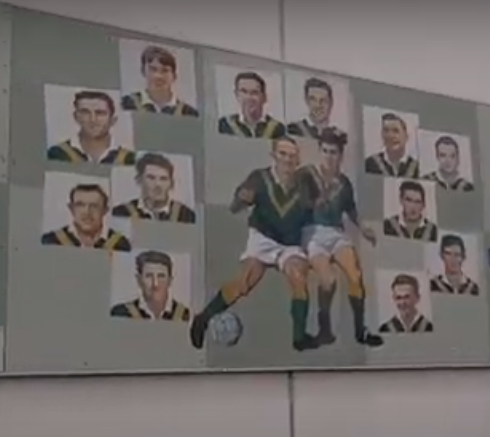
As part of Paul's cultural landmark map project, Paul has started including murals. Prompted by learning of the existence of a soccer mural in the New South Wales town of Kurri Kurri (see right)... so there begins a new phase of trying to chart the game's cultural history. Part of the problem with murals and street art is that their very nature lends them to being vandalised or painted over at frequent intervals.

We also note that there will be an FFA webinar hosted by Andrew Howe and Joe Gorman.

Moving on to 100 Years Ago Today we start with Launceston and the incongruity of starting the season in June; then to Queensland, for an interstate match between Queensland and New South Wales; to Melbourne, where the Collingwood Australian Rules club receives praise for the standard of the club's hospitality to the visiting soccer teams. Still in Melbourne, we perform our usual check of the local results; and finally to Adelaide, where the Prince of Wales' tour continues.

Our guest this week is Greg Werner, an Australian soccer historian specialising in the junior team origins of players capped for Socceroos and Matildas. After going through Greg's history as a soccer  participant - player, coach, referee - we look at his transition to becoming a soccer historian and establishing the Grassroots Football Project. The project aims to find the junior club that Socceroos and Matildas nominate as being the pivotal club - and the pivotal people at those clubs - in terms of igniting their passion for the game. We discuss how a nagging prompt in the form of unanswered question becomes an obsession; the politics of clubs trying to claim representative players as belonging solely to them, often at the expense of smaller, less well-known clubs; the difference in attitudes between male and female players towards being contacted for historical projects; Greg being tapped on the shoulder to assist with the completion of the Encyclopedia of Matildas; players who now eschew any contact related to soccer, having left that in the past; and of course the usual methodological quirks and obstacles encountered while doing historical research.

We finish off by discussing Optus Sport's Football Belongs series, which at the time of broadcasting was just about halfway through its intended run of 14 episodes. The series focuses on European migrant communities and their connections to the local game, intended to line up as a promotional tool for Optus' coverage of the (now cancelled/postponed) Euro 2020 tournament. Paul (who has watched parts of the series) and Ian (who hasn't) discuss the bigger picture of what Optus might be trying to achieve with its efforts here and elsewhere to create Australian soccer history content. We look at what the series - made up of short, five minute episodes focusing on a different ethnic group each time - tries to do. It's an attempt at a remedy for the ethnic club bashing that Australian soccer has taken part in for the better part of the last two or three decades; we look at how that fits in with an apparent general desire to continue on the sort of path of reconciliation, evident since the establishment of the FFA Cup in 2014.

But Paul also discusses the things left out of the series so far, and the discursive issues those absences create. There's the near total lack of women players interviewed, with most women interviewed being at best ancillary members of the soccer community; the lack of almost anyone from outside the specific ethnic groups discussing their place within the specific ethnic club structure they find themselves in; and those people who had been involved with those ethnic soccer clubs, who ended up moving away from that particular scene for various reasons.

To a degree much of this is understandable - the series is meant to be a short, punchy, quietly celebratory look at communities which have nurtured soccer in Australia in difficult circumstances. But Paul wonders whether some balance could've been found for a more even argument's sake; to wit, Paul brings up a piece written in 1995 by the late journalist Wanda Jamrozik, which looks back in a nunaced way at what it was like to support Croydon Kings (then Polonia) in Adelaide back in the early 1970s from the persectpive of a 12 year old girl