Showing posts with label Matildas. Show all posts

Thursday, 15 April 2021

Episode 76 - Heather Reid, Marion Stell and "Women in Boots"

Download and listen to this episode here.

No Ian Syson in the studio tonight, or even via Zoom, and no co-host rustled up either. What is Paul to do other than channel his 2015 uni lecturer self? So Paul puts on a brave face, and dives into what else, but a monologue on trying to identify a problem seemingly ignored by most people practicing the art/hobby of Australian soccer history - that it's not just the game's institutions who ignore or pay mere lip service to Australian soccer history - the great mass of Australian soccer lay community also does the same.

There are great amount of approaches and motivations for those undertaking historical work to do with Australia, almost none lacking validity or nobility... and yet, what's the end game, other those of us engaged in this process looking at each other's work, and mostly failing to engage the Australian soccer community outside our particular interest group?

How do we connect with a culture that seems to exist - and contentedly so - without the burden or gift of knowing of Australian soccer? What if Australian soccer is successful, and popular, without ever needing to resort to deep or even shallow discussions or references to its own history? What is the role of the rare amateur and (rarer still, professional) Australian soccer historian, and their efforts to tell stories, compile statistics, collect memorabilia, and curating archives?

Paul finishes up by wondering if what is really needed for the great mass is not history, but a myth - a unifying story (whether real or not), that allows Australian soccer's participants to feel connected to something (a story, rather than a history) that's bigger than themselves. How you would even concoct such a thing now, when everything is disparate and fractured, is left for another time. 

In the middle segment Paul chats with Marion Stell and Heather Reid about their book Women in Boots: Football and Feminism in the 1970s, which is a predominantly oral history of the first generation of international Australian female soccer players. In the discussion Paul, Marion, and Heather discuss:

  • The research methods involved, including oral histories (with all their potential pitfalls), as well as the scrapbooks maintained by the players and their families.
  • The twin stories of Australian and New Zealand women's soccer, which grow separately and intersect throughout the 1970s and 1980s.
  • The influence of migration -and specifically Englishness - on the fledgling women's soccer scene, for both better and and for worse.
  • The often humiliating fundraising efforts required to enable the players to travel interstate and overseas.
  • The patronising, sexist, misogynistic, and homophobic media coverage
  • The awareness or lack of awareness of the feminist political movements of the time among the players, and their response to it.
  • The poor training, funding, facilities, etc doled out to the women.
  • The nature of personal relationships - including the frequency of which male coaches and personnel around women's football, who became involved with female players; but also the attitudes to lesbianism within the women's football scene.
  • All this, but also much more, including the ordeal of women footballers simply trying to find a suitable pair of soccer boots in the 1970s, and the way many of them came to cherish their pair of boots.

Paul closes out the episode by having a brief chat with FNR producer and presenter Josh Parish about the announcement from SBS that the network will be shutting down its The World Game portal and brand. Paul and Josh discuss the history and influence of the The World Game; the decline in SBS' football offerings over a number of the years; the unknown fate of the portal's archive of reportage and commentary; and the effects on football journalists and the Australian soccer public of having one less outlet solely dedicated to soccer.

Thursday, 8 April 2021

Episode 75 - Greg Werner on the late Vic Dalgleish

Download and listen to this episode here.

We begin this show with a clarification - contrary to popular perception of his public persona, Paul actually thinks Australian soccer is going well, which is not the same thing as his own team going well or not. Then a digression into the fleeting overlap between Australian soccer and professional wrestling.

Some good work in the uploading scene with Mark Boric working with Frankston and Mornington Peninsula soccer historian Laurence Hall. We look at a fine obituary for Matthew Boubaris, a Darwin soccer identity of some note, that appeared in Neos Kosmos.

We finish the segment by looking at soccer (history) videographer Ben Coonan's appearance on Hard Quiz, with his specialty topic of the Socceroos.

Our returning guest this week is Greg Werner to discuss the soccer life of Vic Dalgleish, a notable coach originally from Glasgow, and based in Sydney. But first - we discuss Greg's appearance on Mastermind. Then we follow up a discussion from last week, where we discussed touring English cricket teams in Australia, and the soccer matches they played against local sides. Most curious is the idea that those sides - which sometimes included league footballers - would have been the team in Australia when they were in the country.

We then move on to talk about the legacy of the late Vic Dalgleish, a Football Australia Hall of Fame member, and a prominent coach in Sydney, especially in Sydney suburbs that were not then known for soccer. Dalgleish was a NSW state junior coach, and led the Joeys during a successful period in the 1980s. The testimonials from those See also this brief obituary on the Football Australia website.

Greg sticks around for the 100 Years Ago Today segment, where we begin with Sydney with attempts to "rehabilitate the Commonwealth Football Association". Paul asks the question about when the Australian soccer bodies tried to get the English FA to send a team out, whether the Australian bodies ever tried to include New Zealand as part of their attempt to bring out an English touring team; oh, and the formidable logistics of travel and making your money back. The we try to sort out what flavour of politics was Sydney soccer connected to. Then no signs of argument about whether the Newcastle United Club pf the 1920s can be considered a continuation of its pre-war self. Following is a comparison between the attitudes to women's sports overseas and in Australia, and what women are being allowed to do. And finally to Geraldton, where the three clubs are preparing for the new season.

Thursday, 17 September 2020

Episode 56 - Samantha Lewis and researching Australian women's soccer history

Download and listen to this episode here

We begin this week's episode with Paul getting increasingly upset at Ian's relentless desire for "banter". Then onto the clean-up, with Greg Stock and Mark Boric uploading 1930s and 1940s New South Wales newspapers and news items. George Cotsanis has unearthed a colour photo of Port Melbourne Slavia, winners of the 1963 Australia Cup, and the 1964 Dockerty Cup. We reminisce about Ian's research on this team, which was one the key moments in Ian's career as a soccer historian. We also answer Peter Eedy's question about the fate of the trophies, including the story of the salvaging and refurbishment of the Australia Cup

Paul Nicholls alerted us to an article about soccer in Moss Vale in 1891, which feeds into a segment we brought up early in 2019 about the origins or starting point of soccer in the Macarthur catchment in south-west Sydney.

We also foreshadow a possible look at the state of Australian soccer articles on Wikipedia, via a quick look at two tweets (this one, and this one) which look at the benefits of even minor improvements to articles on Wikipedia. 

In the middle segment we're joined by this week's guest, journalist Samantha Lewis, for this week's edition of 100 Years Ago Today, where there's no Melbourne news! Instead, we begin by following up on last week Newcastle area politicking; head down to Hobart, where the north of the state decides against sending a team south for the return leg of the North vs South fixture; we go back up to Queensland, and Toowoomba, where the town of Harlaxton seems to have produced quite a few school representatives - with Garry McKenzie offering the snippet via social media of a girls' team from Harlaxton in 1917; trying to figure out what it could possibly mean when someone on a team wears their sash over a different shoulder to the rest of the team.

Then on to an article about women bullfighters in Mexico, which leads nicely into a piece about whether women should play football, including references to the Irish feminist Sarah Grand (and thank goodness Sam, who has a background in women's literature, was with us to help us here), which leads to discussion about comparative liberalism of different nations and a whole range of issues. Oh, and there's also the piece by one FAM Webster about whether women should play football. 

In the final segment, we begin with looking at Samantha's article on the Australian representative team which took part in the first Asian Women's Cup in 1975. In this and the previous segment, we have a lengthy and wide ranging discussion, we cover 

  • The legitimacy of the 1975 team which represented Australia at the 1975 Asian Women's Cup.
  • Commentary on feminism
  • Women not being asked about what they think about playing football; commentary is almost exclusively from male points of view
  • Ideas of grace and symmetry as they relate to female athletes
  • Should women athletes try to replicate "male" sporting traits in attitude and culture.
  • History as a cumulative process
  • Women footballers as victims of violence for playing or following football.
  • Women self-regulating their behaviour in order to preempt criticism.
  • Learned vs natural behaviour around soccer.
  • The processes of researching women's soccer history.
  • The prevalence and dominance of oral histories when researching women's soccer.
  • The recurring disappointment of the contextual place of news material about soccer.
  • Lack of continuities in women's soccer, and the struggle in the search for deep cultural perspectives, because of the lack of documentary evidence of women's soccer.
  • Cultural self-doubt and internalisation of the lack of importance of what women athletes do.

Thursday, 4 June 2020

Episode 42 - Greg Werner and Grassroots Football Project

Apologies for the technical issues, as usual. Maybe even a bit more this week.

Download and listen to episode 42 here.

We begin the Mark Boric Express - he's still uploading stuff, and still struggling to make sense of rectifying incorrect and incomplete Victorian results and league tables from the 1920s and 1930s. This leads to an esoteric discussion about mythical sources documents and regressing into unrecorded pre-histories.

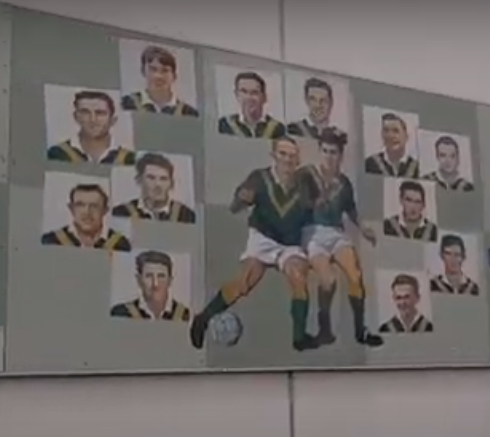
As part of Paul's cultural landmark map project, Paul has started including murals. Prompted by learning of the existence of a soccer mural in the New South Wales town of Kurri Kurri (see right)... so there begins a new phase of trying to chart the game's cultural history. Part of the problem with murals and street art is that their very nature lends them to being vandalised or painted over at frequent intervals.

We also note that there will be an FFA webinar hosted by Andrew Howe and Joe Gorman.

Moving on to 100 Years Ago Today we start with Launceston and the incongruity of starting the season in June; then to Queensland, for an interstate match between Queensland and New South Wales; to Melbourne, where the Collingwood Australian Rules club receives praise for the standard of the club's hospitality to the visiting soccer teams. Still in Melbourne, we perform our usual check of the local results; and finally to Adelaide, where the Prince of Wales' tour continues.

Our guest this week is Greg Werner, an Australian soccer historian specialising in the junior team origins of players capped for Socceroos and Matildas. After going through Greg's history as a soccer  participant - player, coach, referee - we look at his transition to becoming a soccer historian and establishing the Grassroots Football Project. The project aims to find the junior club that Socceroos and Matildas nominate as being the pivotal club - and the pivotal people at those clubs - in terms of igniting their passion for the game. We discuss how a nagging prompt in the form of unanswered question becomes an obsession; the politics of clubs trying to claim representative players as belonging solely to them, often at the expense of smaller, less well-known clubs; the difference in attitudes between male and female players towards being contacted for historical projects; Greg being tapped on the shoulder to assist with the completion of the Encyclopedia of Matildas; players who now eschew any contact related to soccer, having left that in the past; and of course the usual methodological quirks and obstacles encountered while doing historical research.

We finish off by discussing Optus Sport's Football Belongs series, which at the time of broadcasting was just about halfway through its intended run of 14 episodes. The series focuses on European migrant communities and their connections to the local game, intended to line up as a promotional tool for Optus' coverage of the (now cancelled/postponed) Euro 2020 tournament. Paul (who has watched parts of the series) and Ian (who hasn't) discuss the bigger picture of what Optus might be trying to achieve with its efforts here and elsewhere to create Australian soccer history content. We look at what the series - made up of short, five minute episodes focusing on a different ethnic group each time - tries to do. It's an attempt at a remedy for the ethnic club bashing that Australian soccer has taken part in for the better part of the last two or three decades; we look at how that fits in with an apparent general desire to continue on the sort of path of reconciliation, evident since the establishment of the FFA Cup in 2014.

But Paul also discusses the things left out of the series so far, and the discursive issues those absences create. There's the near total lack of women players interviewed, with most women interviewed being at best ancillary members of the soccer community; the lack of almost anyone from outside the specific ethnic groups discussing their place within the specific ethnic club structure they find themselves in; and those people who had been involved with those ethnic soccer clubs, who ended up moving away from that particular scene for various reasons.

To a degree much of this is understandable - the series is meant to be a short, punchy, quietly celebratory look at communities which have nurtured soccer in Australia in difficult circumstances. But Paul wonders whether some balance could've been found for a more even argument's sake; to wit, Paul brings up a piece written in 1995 by the late journalist Wanda Jamrozik, which looks back in a nunaced way at what it was like to support Croydon Kings (then Polonia) in Adelaide back in the early 1970s from the persectpive of a 12 year old girl

Thursday, 5 December 2019

Episode 30 - Lee McGowan and the Matildas; remembering Pim Verbeek; ball boys

Download and listen to episode 30 here.

On this week's episode, fill-in co-host for Ian Syson, Tony Persoglia, is sick, so we've co-opted Lee McGowan - who was in the studio to talk about his book anyway - for the whole hour.

We begin as we usually do, by noting the progress of the Mark Boric Express, which this week saw Mark meet up with Greg Stock somewhere in the middle of the regional Victoria to make an exchange. Check out Mark's Twitter feed for news of his updates, or head straight to the where all the goodness ends up.

The former Socceroos coach Pim Verbeek died last week, and we have a segment which covers the somewhat perplexing (to Paul, and a few others) reaction to Verbeek's passing - someone who was arguably largely unloved across the board during his time as Socceroos coach from 2007-2010. Yet as news of his passing came to light last week, there was a respect shown online for Pim that seemed to surpass mere sincere condolences for his family and friends. We look back at how Pim came to be Socceroos coach (including a diversion into the man he beat for the job, one time coaching wunderkind Philippe Troussier); his blunt, honest manner on the quality of the players at his disposal, and the quality of the A-League; the still mystery laden disaster of the Socceroos' opening game of the 2010 World Cup, and the reaction to that at the time; and the ways in which perhaps those in the media and football administration got to see a different side of Pim than what the public did.

(see also Bonita Mersiades' piece remembering Pim Verbeek)

We also noted that a new sports museum has opened in the small town of Rochester (about 180kms north of Melbourne), specialising in sports apparel from the 4,000 item strong collection of John Forbes (not the poet), who worked at Puma for 24 years. The museum probably specialises in cricket and AFL merch, but it's not known what soccer material the museum has in its collection - so if that was the main purpose of your visit, it'd probably be best to call the museum in advance. The museum is open on Thursdays, Fridays, Saturdays, and Sundays from 10am to 4pm, and at other times by appointment. The museum doesn't have a website, but it does have a Facebook page.

In 100 Years Ago Today we look at the big announcement that the English are investigating the possibility of sending a team to Australia and New Zealand in 1921 - provided the 'dominions' can stump up the cash; more soccer folk playing cricket in the summer, this time in inner-Melbourne; some confusing same-day articles in the Wollongong press, which seem to contradict and/or supersede each other; and the brief story of one K. McCredle, a Sydney schoolboy who was a talented cricketer, and before that a talented soccer player - before his school, Sydney Boys High, discontinued its soccer program.

(see also this 2009 piece by Spiro Zavos on The Roar about the decline of rugby at Sydney Boys High, partly replaced as a sport of choice by soccer, but also due to, *cough* demographic changes *cough*)

After that extended opening, we chat to Lee McGowan about his and Fiona Crawford's new book Never Say Die: The Hundred-Year Overnight Success of Australian Women's Football (published by NewSouth), a discussion  which covers, among other things:
  • The early days of women's soccer in Australia, especially in Queensland.
  • The difficulties involved with researching women's sport in Australia.
  • Buried histories, broken continuities, and the predominance of relying on oral histories.
  • The difficulties faced by women's soccer in this country -covering funding, infrastructure, wages, injuries, but most of all, a deficit of respect.
  • The difficulty and necessity of building a culture which can withstand innumerable setbacks and overcomes many obstacles, while somehow leaving a legacy for the following generations.
  • The need to avoid imitating male sporting cultures, all while acknowledging the positive effect many men have had on the Matildas and women's soccer - but also emphasising the need to develop and promote female coaches. referees and administrators
  • And of course, the development of the Matildas from obscurity in the 1970s to mainstream, well-loved brand in the 2010s.
The episode also makes the occasional detours into football literature, ball boys, and Terry Venables.